


Winter Battery Care for 4x4s: Don’t Let the Cold Kill Your Adventure

Cold weather reduces available battery power while increasing the power needed to crank a 4×4 engine.
There are few sounds more disappointing than a 4×4 trying to start on a freezing winter morning with a battery that has already given up the fight. Here are some 4×4 winter battery care tips.
You know the scene. The fridge is packed. The camper is hitched. The kids are rugged up. The dog is already sitting in the back like he owns the place. You turn the key, or press the start button, and instead of that familiar diesel rattle or petrol bark, you get the slow, tired groan of a starter motor asking for help.
Then comes the click.
Then silence.
Winter has a nasty habit of finding the weakest part of your touring setup, and very often that weak link is the battery. Not because the battery was necessarily faulty yesterday, but because cold weather exposes batteries that are old, undercharged, poorly maintained or being asked to do too much.
For 4×4 owners, the problem is even bigger than it is for the average daily driver. A touring vehicle is rarely just a vehicle. It might be running a fridge, lights, UHF, compressor, diesel heater, inverter, phone chargers, dash camera, electric brake controller, winch, canopy power system, caravan charging circuit and a dual-battery setup. Add cold mornings, short trips, muddy tracks, snow country or a vehicle that sits unused between adventures, and suddenly the battery has a lot more on its plate than simply starting the engine.

Cold weather can reduce battery capacity, making winter battery checks essential before 4×4 and caravan touring.
Why winter hurts batteries
Here’s the science in plain English.
A battery relies on chemical reactions to produce electrical energy. When the temperature drops, those reactions slow down. That means the battery cannot deliver the same amount of current as easily as it can on a warm day.
At the same time, the engine is harder to turn over. Cold oil is thicker, internal friction is higher, glow plugs may be working harder on diesel engines, and the starter motor needs more current to crank the engine properly.
That is the cruel little trick winter plays. Your battery produces less power at exactly the same time your 4×4 needs more of it.
Century Batteries says a battery can lose up to 35 percent of its cranking capacity when temperatures fall to around 0°C, and CTEK notes that the available cranking power can fall sharply as temperatures drop. That is why a battery that seemed fine during summer can suddenly sound lazy on the first proper cold morning of winter.

Corroded battery terminals can create resistance, voltage drop and poor starting performance in cold weather.
The 4×4 problem: one vehicle, two electrical worlds
Most touring 4x4s have two very different battery jobs.
The starting battery has one main role: deliver a big hit of current for a short period to start the engine.
The auxiliary battery, or house battery, has a different job. It is there to run accessories over a longer period: fridge, camp lights, water pump, inverter, communications gear, diesel heater, canopy outlets and sometimes the caravan charging system.
The trouble starts when those two jobs get mixed together.
If your starting battery is being dragged down by accessories, or your auxiliary battery is not being recharged properly after each trip, winter will eventually find the problem. The result might be a warm fridge and a flat camp battery, or worse, a 4×4 that will not start when you are parked at a remote campsite with no phone reception.
That is why good winter battery care is not just about the battery under the bonnet. It is about the whole 12-volt system.

Basic tools, gloves and eye protection make battery-terminal cleaning safer and more effective.
Start with the starting battery
Before winter really bites, have the starting battery tested. Not guessed. Tested.
A proper battery test will show whether the battery still has the cranking capacity needed to start the vehicle reliably. This matters even more if the battery is three years old or more, if the vehicle has been doing short runs, or if the first start of the morning is beginning to sound slower than normal.
Listen to the vehicle. It will often warn you before it strands you.
If the starter sounds slower first thing in the morning, if the dash lights dip heavily during cranking, or if the vehicle starts perfectly after a drive but struggles when cold, the battery may be nearing the end of its useful life.
Do not wait until it fails at 5am in the rain.

The fizzing reaction shows the bi-carb soda neutralising acidic corrosion around the terminal.
Clean terminals make a real difference
One of the simplest battery checks is also one of the most overlooked.
Open the bonnet and inspect the battery terminals. Look for white, green or blue crust around the posts and clamps. Check that the terminals are tight. Check that the cables are not rubbing, cracked, loose or strained. Follow the earth lead and make sure the connection to the body or engine is clean and secure.
A battery can be healthy and still perform poorly if the current cannot get through the terminals properly. Corrosion creates resistance. Resistance creates voltage drop. Voltage drop creates slow starts, strange electrical behaviour and unnecessary stress on the battery and starter motor.
If you clean the terminals yourself, wear safety glasses and gloves, disconnect the battery correctly, and follow the vehicle manufacturer’s instructions. Modern vehicles can be sensitive to battery disconnection, and some may require memory saving, reset procedures or battery registration after replacement.
The old backyard approach of yanking the terminals off and hoping for the best is not always the right answer on a modern 4×4.

A clean, tight battery terminal helps reduce voltage drop and improves starting reliability.
The auxiliary battery: don’t let the fridge win
The auxiliary battery is where many touring setups quietly fall over.
A fridge might only draw a modest amount of current when it is cycling, but leave it running long enough, add camp lights, phone charging, a diesel heater and a few cloudy days, and the numbers start to matter. In winter, solar input can also be lower because the days are shorter, the sun angle is lower, and the vehicle may be parked under trees, beside a hut or in a shaded valley.
That means your auxiliary battery may not be getting back to full charge as often as you think.
Lead-acid, AGM and deep-cycle batteries do not like sitting partially discharged. Leave them low for too long and sulphation starts to become the enemy. Sulphation is the build-up of lead sulphate crystals on the battery plates. Once it gets bad enough, the battery loses capacity and may never fully recover.
In simple terms, a flat battery that is quickly recharged may live to fight another day. A flat battery left sitting for weeks may be permanently damaged.
 Lithium batteries still need respect
Lithium auxiliary batteries have become popular in touring vehicles for good reason. They are lighter than comparable AGM or lead-acid batteries, can provide strong usable capacity, and many include an internal Battery Management System to help protect against overcharge, over-discharge and short circuit conditions. REDARC also notes the weight and charging advantages of lithium deep-cycle batteries in touring applications.
But lithium does not mean fit-and-forget.
The battery must be matched to the right charger profile. The DC-DC charger, solar regulator and mains charger all need to suit the battery chemistry. You should also understand the battery’s low-temperature charging limits. Some lithium batteries protect themselves through the BMS, while others may require specific chargers or temperature-controlled installation.
If your 4×4 or canopy has a lithium battery mounted in a cold location, such as a tray box or external compartment, check the manufacturer’s specifications before winter touring. A lithium battery that works beautifully in summer may behave differently during a frosty alpine morning.
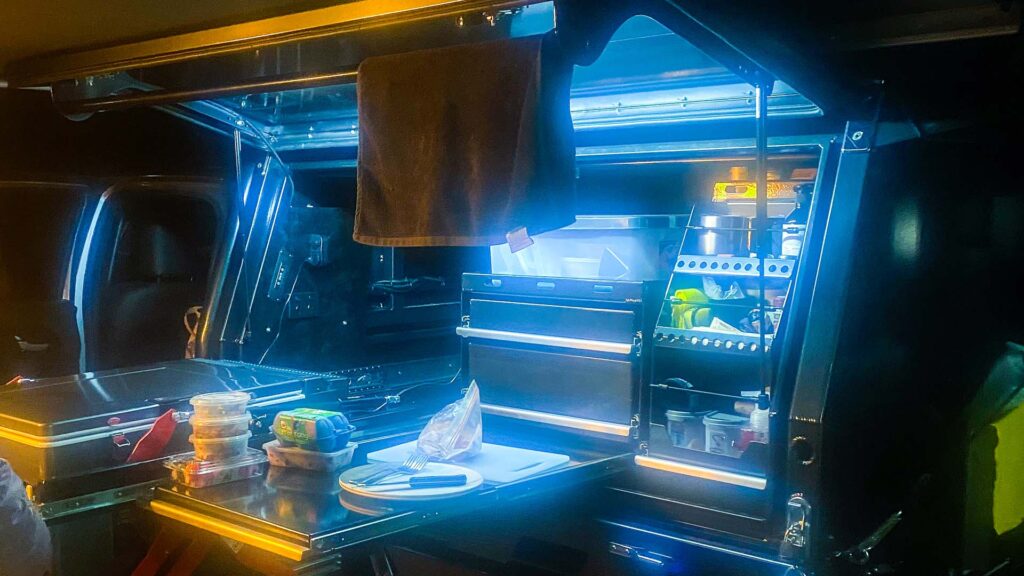
The inclusion of a slide-out pantry in the alloy canopy brings an element of organisation and accessibility to outdoor cooking.
Short trips are battery killers
A lot of 4x4s live strange lives.
They sit in the driveway all week, run to the shops, do the school pickup, maybe tow the camper once a month, and then are expected to run half a campsite when the weekend arrives.
That sort of use can be hard on batteries. The starting battery may never get a proper recharge after each start, and the auxiliary battery may slowly lose charge between trips due to small parasitic loads from monitors, chargers, alarms, trackers, fridges, brake controllers, Bluetooth modules and canopy accessories.
RACQ points out that modern vehicles place far greater demand on batteries than older vehicles did, and that batteries benefit from regular use or being kept on a charger.
So if your 4×4 is not being used regularly, plug it into a quality smart charger. If you have a caravan or camper trailer, do the same with its battery system. A smart charger or battery maintainer is cheap insurance compared with replacing batteries that have been left to slowly die.

Projecta’s 2000 Watt inverter can punch up to 4000 Watts peak power and 2000 watts constant load.
Don’t trust the dashboard alone
Many modern 4x4s give you a voltage reading somewhere on the dash, in an app, or through an aftermarket battery monitor. That is useful, but it is not the full story.
Voltage gives you a clue. It does not always tell you battery health.
A weak battery may show reasonable voltage with no load, then collapse when asked to crank the engine or run accessories. That is why a proper load test or conductance test is important. It checks how the battery performs under demand, which is what matters on a cold morning.
The same applies to auxiliary batteries. A monitor that shows state of charge is helpful, but only if the system is properly calibrated and the battery is being fully charged often enough.
Winches, compressors and winter tracks
Winter touring often means harder electrical work.
Tyre pressures are dropped for sand, mud, snow or rough tracks, then the compressor gets a workout at the end of the day. A winch recovery can pull enormous current. Driving lights, wipers, demisters, heaters and heated seats all add load. If you are towing, the vehicle may also be charging the caravan or camper battery while running lights and brake control systems.
None of these loads are a problem when the charging system is healthy and the batteries are strong. But if the starting battery is marginal, the auxiliary system is undercharged, or the alternator is not keeping up, winter will reveal the weakness.
Before a winter trip, check the whole system. Not just the battery.
Confirm alternator output. Inspect belt condition. Check battery terminals. Inspect earth points. Check the DC-DC charger. Inpect solar input. Check the condition of Anderson plugs and trailer connections. Make sure the winch isolator, cables and terminals are clean and secure.
A 4×4 battery system is only as strong as the worst connection in it.

Würth Battery Terminal Protector helps seal the terminal against moisture and future corrosion.
Storage: don’t park it and forget it
If the 4×4, camper or caravan is parked up between trips, battery maintenance becomes even more important.
Do not put the vehicle away with low batteries. Fully charge the starting battery and auxiliary battery before storage. If possible, connect them to suitable smart chargers or maintainers. If the vehicle is stored outside, make sure solar is actually doing its job and not being shaded by a carport, tree, roof rack load or dirty solar panel.
A solar panel covered in dust, leaves or bird droppings is not a charging system. It is a decoration.
For caravans and camper trailers, isolate non-essential loads where appropriate. Check whether the battery management system has a storage mode. Make sure the breakaway battery, if fitted, is maintained according to the manufacturer’s instructions.
And remember, a battery does not need to be working hard to go flat. Small parasitic loads over a long period can quietly drain it.

Real-time monitoring allows travellers to track battery levels, charging performance and power usage from a single display.
A simple winter battery checklist for 4×4 owners
Before winter touring, check the following:
- Test the starting battery, especially if it is more than three years old.
- Clean and tighten battery terminals.
- Inspect earth straps and main battery cables.
- Check alternator output and drive belt condition.
- Make sure the auxiliary battery reaches full charge.
- Confirm the charger settings match the battery type.
- Check solar panel output and clean the panels.
- Inspect Anderson plugs, trailer plugs and canopy wiring.
- Check fridge settings and low-voltage cut-out levels.
- Charge the caravan or camper battery before leaving home.
- Carry a suitable jump starter or jumper leads, but know how to use them safely.
- Do not ignore slow cranking on cold mornings.

Redarc Manager 30 provides intelligent power management for reliable off-grid operation.
Be careful with jump starting
Jump starting a modern 4×4 is not always as simple as it was on an old farm ute.
Modern vehicles are full of electronics. Incorrect jump starting can damage control modules, sensors or charging systems. Always follow the owner’s manual. Use quality leads or a suitable lithium jump starter. Connect to the recommended jump points if the vehicle has them.
If the battery has frozen, is swollen, leaking, cracked or smells strongly of acid, do not jump start it. Replace it.
And if you are regularly relying on a jump starter, you have not solved the problem. You have simply bought yourself a temporary escape route.

The Slide-On camper adds additional sleeping space when family and friends join our camp.
Final thought
A good winter 4×4 trip should be remembered for misty campsites, quiet tracks, campfire yarns, mountain air and that first hot coffee in the morning.
Not for a dead battery.
The good news is that winter battery failure is often preventable. Keep your batteries charged. Keep the terminals clean. Test the starting battery before it lets you down. Make sure the auxiliary system is matched to the way you actually use the vehicle. And do not assume that because everything worked last summer, it will be fine on a cold morning in the High Country, Tasmania, the Snowy Mountains or the back blocks of Victoria.
Your battery is not the most exciting part of your 4×4.
But when it fails, it becomes the most important part of the whole trip.
Related reading:
- Project ICB2000 Power Board Review
- Air Safe Hitch Review
- How to prevent caravan sway
- Gold Class LC17C Touring 2+1 review

